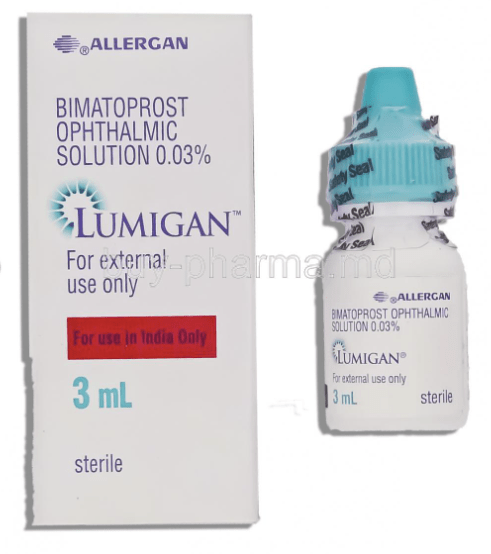
If you’ve heard of the prescription eye drop Bimatoprost, but you’re not sure what it is or what it does, this article will help you better understand this treatment. Listed below are some of the main benefits and side effects of Bimatoprost, including lowered intraocular pressure. You’ll also learn about bacterial keratitis and eyelash growth.
Buy Lumigan (Genric Bimatoprost)
Bimatoprost is an antiglaucoma and miotic agent
The drug is a structural prostaglandin analog. In a clinical study, bimatoprost 0.03% was applied to the cornea and conjunctiva of healthy volunteers over a period of two weeks. The drug reached peak blood concentrations in 10 minutes and its lower limit of detection in 1.5 hours. This drug is well distributed in body tissues, including the plasma, but has not been detected in human milk. Therefore, breastfeeding should be considered in conjunction with bimatoprost use.
The drug is used to reduce elevated intraocular pressure in patients with open-angle glaucoma, ocular hypertension, and chronic ocular hypertension. Bimatoprost is also used to treat eyelash hypotrichosis, a symptom of glaucoma. In some cases, bimatoprost is used alone, or as an adjunct therapy to beta-blockers.
While bimatoprost is relatively safe, some patients may experience allergic reactions. An increased pigmentation of the iris can occur. However, this pigmentation will usually disappear once the therapy is stopped. Bimatoprost is effective in lowering intraocular pressure, but it can also cause skin hyperpigmentation. Although there is no known long-term side effect, a rash or iris pigmentation may occur.
However, cholinergic have a range of systemic and ocular side effects. The potential for redness, iris pigmentation, and cataract formation are among the side effects of bimatoprost use. Some ocular side effects include ciliary muscle spasm, redness, and uveitis. These side effects can be distracting for younger patients and can worsen vision in older patients who are already suffering from cataracts.
It lowers intraocular pressure
A synthetic prostamide, bimatoprost lowers intraophthalmic pressure (IOP) by increasing the outflow of aqueous humor and the trabecular meshwork. Although the exact mechanism of bimatoprost’s intraocular pressure lowering is not known, it may have beneficial effects on patients suffering from ocular hypertension and glaucoma.
Bimatoprost is contraindicated in patients with active ocular infections, prior corneal transplantation, absent posterior lens capsule or ruptured anterior chamber, or history of hypersensitivity. In phase III trials, patients reported a feeling of a foreign body in the eye. Symptoms of adverse reactions included eye pain, conjunctival hemorrhage, dry eye, and iritis.
The present invention relates to a preservative-free bimatoprost ophthalmic solution. The composition contains 0.03% w/v bimatoprost, 0.268% w/v sodium phosphate heptahydrate, 0.14% w/v citric acid monohydrate, and 0.83% w/v sodium chloride. The solution has a pH of about 7.3.
The use of bimatoprost is approved for the treatment of elevated IOP in patients with glaucoma and ocular hypertension. It is prescribed once daily in the affected eye. Bimatoprost 0.3% ophthalmic solution is compatible with other topical ophthalmic agents, provided they are used at least five minutes apart. It should be avoided in patients with active intraocular inflammation, aphakia, or a history of macular oedema.
Initially, bimatoprost can cause redness, watering, or irritation of the eye. If this happens, you should rinse the eye thoroughly with water and wait a few minutes. The irritation or watering should subside on its own within a few hours. However, it is important not to apply the medication too often, because it may result in serious side effects. Bimatoprost may stain contact lenses, so it is best to remove contact lenses before using the drops.
It causes macular edema
Bimatoprost is a topical medication prescribed to treat glaucoma. It works by blocking the production of prostaglandins, the chemicals responsible for inflammation and swelling in the eye. The eye’s macula is important for clear vision and any inflammation or swelling in this area of the eye can have devastating consequences. It is also more likely to develop if the lens is damaged or missing.
Other causes of macular edema include radiation exposure, eye surgery, and medications that contain prostaglandins, such as brimonidine and enoxaparin. In cases of recurrent macular edema, the treatment for this condition varies. It can be treated with intra-ocular injections of a prostaglandin-containing agent or a combination of both.
In the trial, bimatoprost was administered to 30 eyes in 30 patients for 6 months. The study found no significant differences in macular parameters between the two drugs. IOP decreased by 20% to 25% from baseline. Both macular thickness and macular volume were not significantly changed during the three-month period. The study was designed to determine which drug had the greatest positive effect on macular edema.
There are risks associated with bimatoprost, including bacterial keratitis and contact lens complications. Benzalkonium chloride can cause eye infections, so contact lens wearers should remove their contact lenses before administering Lumigan. Benzalkonium chloride can cause damage to soft contact lenses. After using Lumigan, close your eyes and wait 15 minutes before putting them back in.
In addition to a positive association with macular edema, latanoprost has a high rate of incidence in patients with glaucoma. The risk of developing cystoid macular edema is correlated with the severity of the disease. In patients with preservative-free latanoprost, the risk is less.
It causes bacterial keratitis
Bacterial keratitis is an acute infection of the cornea caused by bacteria, fungi, viruses, and Acanthamoeba. It can also be caused by the improper use or storage of eye drops, certain systemic diseases, or contact lens wear. Pharmacists can play an important role in educating patients about the symptoms and treatment options for keratitis. In addition to prescribing appropriate eye drops, pharmacists can help educate patients on how to use these medications and how to store them properly.
Bimatoprost is a colorless, odorless powder. It is highly soluble in methyl alcohol and ethyl alcohol. It is insoluble in water and isotonic. In a single drop of Lumigan, 0.3 mg of bimatoprost are dissolved in 15 milliliters of water. It is diluted with sodium chloride to adjust the pH level.
In addition to its antibacterial action, bimatoprost may cause a reaction in the eye. Symptoms may include eyelid or conjunctivitis, sudden decrease in visual acuity, and an increase in the intraocular pressure. Bimatoprost is usually applied on the upper eyelid margins. Bimatoprost is not considered a contraindication for the treatment of bacterial keratitis, but the preservative benzalkonium chloride may have clinically important effects in some individuals.
Patients who use bimatoprost 0.03% ophthalmic solution should monitor their symptoms closely and consult a health care provider if they notice any side effects. Although bimatoprost causes bacterial keratitis in humans, there have been no reports of an overdose. While bimatoprost does not appear to cause bacterial keratitis, it does produce a bacterium that causes it.
It is effective for eyebrow thinning
One study published in the New England Journal of Medicine in 2012 compared bimatoprost 0.03% to 3% minoxidil. While the two agents are chemically similar, they are not the same. The researchers compared the two drugs in a randomized, double-blind, split-face study. Bimatoprost was found to be effective for treating eyebrow thinning and hair loss.
The drug is applied to the eyebrows daily for 36 weeks, and has shown promise as a treatment for thinning eyebrows. The drug has been proven to make terminal hairs longer, thicker, and darker. Furthermore, bimatoprost makes vellus hairs and lightly pigmented hairs more noticeable. However, this treatment is not for everyone. For this reason, many people may not find bimatoprost effective for eyebrow thinning.
Among those who suffer from eyebrow thinning, 0.03% bimatoprost was proven to be safe and effective in a study. Patients were randomized to either bimatoprost 0.03% once daily or twice a day for seven months. The primary endpoint was eyebrow fullness at Month 7, while secondary endpoints included eyebrow darkness and patient satisfaction with treatment.
This study showed that bimatoprost QD was significantly effective for eyebrow thinning. In a second study, bimatoprost BID and QD significantly reduced the darkness of the eyebrows in a similar fashion. Additionally, the drug reduced balding and darkened eyebrows compared to the vehicle group. The researchers compared the results with ESS Item 6 and other standardized measures.
The bimatoprost eye drop was approved by the FDA in 2008 to treat glaucoma. This drug’s active ingredient, bimatoprost, re-invigorates the prostamide receptor in the scalp and hair follicle, causing them to enter the anagen phase. Bimatoprost is safe and effective in treating eyebrow thinning.
 latest news blog